DIY Jump Start Safety – What to Do When Your Car Won't Start in Dallas
Dead battery in a parking lot, at home, or on a Dallas highway? Knowing how to safely jump start your car can save time and money. Here's the correct procedure—and the dangerous mistakes to avoid.
Before You Jump: Safety Checklist
Never Jump Start If:
- Battery is cracked, leaking, or swollen — risk of explosion
- You smell sulfur (rotten eggs) — battery is venting hydrogen gas
- Battery terminals are heavily corroded (clean first or call for help)
- Car has visible electrical damage (melted wires, burnt smell)
- It's a hybrid or full EV (different procedure—call professional)
Safe to Jump Start If:
- Battery looks normal (no cracks or leaks)
- Car simply won't crank or clicks when you turn the key
- Dashboard lights are dim or off
- Battery is accessible (not buried in trunk or under seats)
What You'll Need
- Jumper cables (at least 12 feet long, 4-6 gauge wire)
- Donor car with a fully charged battery (or portable jump pack)
- Safety glasses (optional but recommended)
- Gloves (if terminals are corroded)
Jump Start Procedure (Step-by-Step)
Step 1: Position the Cars (1 minute)
- Park donor car close to dead car (front-to-front or side-by-side)
- DO NOT let cars touch — leave 6-12 inches of clearance
- Turn off both cars completely (keys out, all accessories off)
- Set parking brakes on both vehicles
- Pop both hoods and locate batteries
Step 2: Identify Battery Terminals (1 minute)
Positive (+): Usually marked with a red cap or "+" symbol
Negative (−): Usually marked with a black cap or "−" symbol
Critical: If terminals are heavily corroded (white/blue crusty buildup), clean them first with baking soda + water or call for help.
Step 3: Connect Cables in Correct Order (CRITICAL!)
Follow this order EXACTLY—wrong connections can damage electronics or cause sparks/explosions.
- Red (+) to DEAD battery positive
Attach red clamp to positive terminal of dead battery
- Red (+) to DONOR battery positive
Attach other red clamp to positive terminal of donor battery
- Black (−) to DONOR battery negative
Attach black clamp to negative terminal of donor battery
- Black (−) to GROUND on dead car
DO NOT connect to dead battery negative terminal!
Instead, attach to unpainted metal surface on engine block or frame (away from battery)
Why ground instead of negative terminal?
Dead batteries produce hydrogen gas. Sparks near the battery can ignite it. Grounding to the engine block keeps sparks away from the battery.
Step 4: Start the Donor Car (2-3 minutes)
- Start the donor car and let it run at idle
- Wait 2-3 minutes to allow charge to transfer
- Optional: Rev donor engine to 1,500-2,000 RPM (helps charge faster)
Step 5: Start the Dead Car (1 minute)
- Turn key in dead car (or press start button)
- If it doesn't start immediately, wait 30 seconds and try again
- If it still doesn't start after 3 attempts, stop and call for help (may be alternator or starter issue)
Step 6: Disconnect Cables (REVERSE Order)
Once the dead car is running, disconnect cables in reverse order:
- Black (−) from ground on previously dead car
- Black (−) from donor battery
- Red (+) from donor battery
- Red (+) from previously dead battery
Important: Don't let clamps touch each other while disconnecting!
After Jump Starting: Next Steps
Drive Immediately (Don't Turn Off!)
- Drive for 15-30 minutes to recharge the battery
- Use highways if possible (higher RPMs = faster charging)
- Avoid stopping until battery has recharged
- Turn off accessories (radio, AC, heated seats) to maximize charge
Get Battery Tested Within 24 Hours
A jump start doesn't fix the underlying problem. Common causes:
- Old battery (3+ years): Replace before it dies again
- Failing alternator: Won't recharge battery while driving
- Parasitic drain: Something (interior light, glove box light, aftermarket accessory) is draining battery when off
Free battery testing in DFW: AutoZone, O'Reilly, Advance Auto Parts, or call David's for mobile testing at your location.
Jump Packs: The Safer Alternative
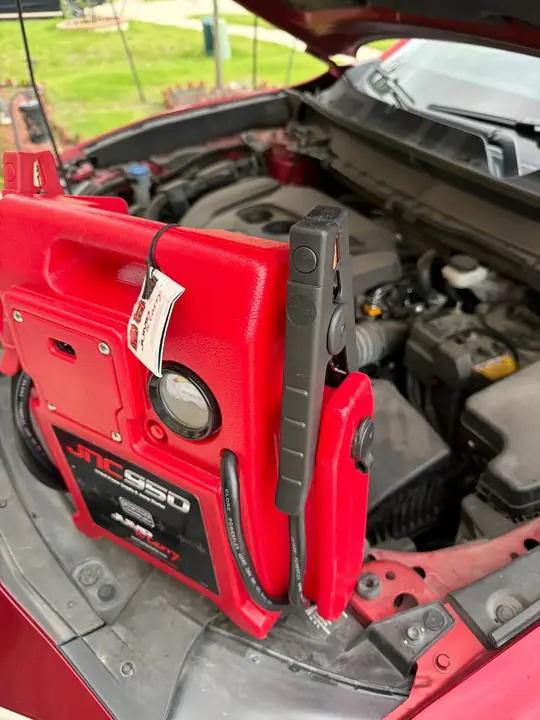
Portable jump starters (jump packs) eliminate the need for another car and reduce the risk of mistakes.
How to use a jump pack:
- Connect red (+) clamp to positive terminal
- Connect black (−) clamp to negative terminal or ground
- Turn on jump pack
- Start your car
- Disconnect and turn off jump pack
Recommended jump packs for DFW drivers:
- NOCO Boost Plus GB40: 1,000 amps, good for V6 engines (~$100)
- Stanley J5C09: 1,000 amps, includes air compressor (~$80)
- Clore Automotive JNC660: 1,700 amps, heavy-duty for trucks (~$150)
David's Mobile Jump Start Service
Available 24/7 across Dallas, Fort Worth, Arlington, Irving, Plano, Frisco, and all DFW cities. We jump start your car, test your battery and alternator on-site, and replace batteries if needed—all at your location. Call 682-267-0991 anytime.
Common Jump Start Mistakes (and How to Avoid Them)
- Touching clamps together: Creates sparks and can damage batteries. Keep clamps separated until connected.
- Reversing polarity (red to negative, black to positive): Can fry car's computer and alternator. Double-check connections!
- Connecting black to dead battery terminal: Sparks near battery = explosion risk. Always ground to engine block.
- Turning off car immediately after jump: Battery won't recharge. Drive 15-30 minutes minimum.
Frequently Asked Questions
Dead Battery in DFW?
24/7 mobile jump start and battery replacement—we come to you