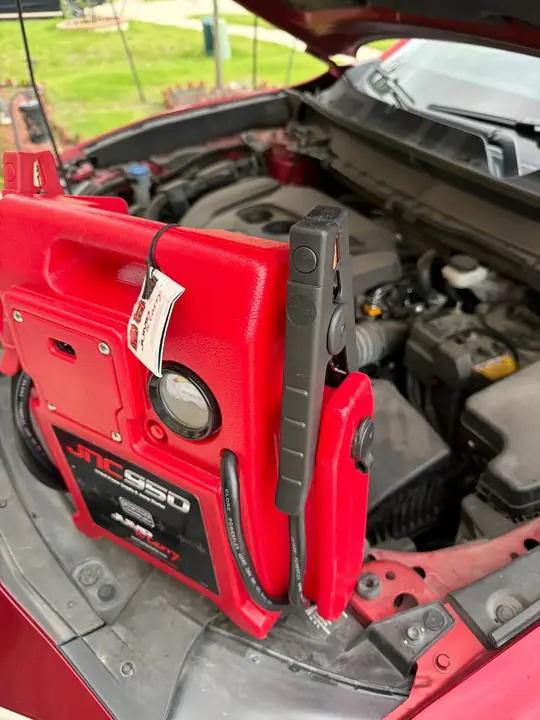
Can You Jump Start a Car With a Bad Alternator? (DFW Guide)
 By Dave Salazar
You can jump start a car with a bad alternator, but the engine will only stay running until the battery's stored charge runs out — usually 5–30 minutes. The dash battery light staying on after a jump is the #1 sign the alternator (not the battery) is the real failure.
Short answer: yes — you can jump start a car with a bad alternator, but the engine will only stay running for as long as the battery has stored charge left. Once that's gone (usually 5–30 minutes), the car dies again and a second jump won't help. We get this call all over Dallas-Fort Worth, and 9 times out of 10 the driver thinks the battery is dead when the alternator is the real culprit.
How a Bad Alternator Imitates a Dead Battery
The alternator is what recharges the battery while you drive. It's belt-driven off the engine, and at idle a healthy unit outputs 13.8–14.4V at roughly 100–150 amps. That output keeps the battery topped off and feeds every electrical load on the car — fuel pump, ignition, ECU, headlights, infotainment, climate, blower motor, fan clutches. When the alternator fails, your battery is the only power source for all of that. It drains in hours instead of weeks.
Drivers crank it, the engine fires, the car dies — and the symptoms look identical to a dead battery. That's why a jump from a Good Samaritan in a 7-Eleven parking lot off I-35E feels like it worked… until you hit Stemmons and the car dies at the next light. By the time most DFW drivers call us, they've already had two failed jumps and are convinced the battery is "just bad." The real culprit is upstream.
5 Signs the Alternator Is the Real Problem
- Battery light stays on after the jump. The most common tell. The dash icon means "charging system fault," not "battery low." A working alternator turns that light off within seconds of starting.
- Headlights dim at idle, brighten when you rev. Output is too low at idle to feed accessories and recharge the battery. As RPM climbs, the alternator spins faster and produces more current — the headlights pulse with the throttle.
- Engine dies within minutes of the jump. No alternator output = the battery is the sole power source, and it's already depleted from cranking.
- Voltmeter reads under 13.8V at the battery posts with the engine running. Healthy alternators output 13.8–14.4V. Under 13V at idle is a failing alternator. Over 15V is an overcharging alternator — also a failure, and it cooks the battery within weeks.
- Weird electrical glitches. Flickering dome light, infotainment reboot, speedometer twitch, climate fan surging — when voltage is unstable, every module on the bus complains. Modern cars have 30–80 modules; they all hate dirty power.
The Math: How Long a Jumped Car Actually Runs
A 12V flooded car battery stores roughly 45–60 amp-hours of usable charge. Modern engines draw 30–50 amps just to keep the fuel injectors, ignition, and ECU alive at idle — more with A/C on, which in Texas is always. That math gives you 30–90 minutes of runtime on a fully-charged battery with zero alternator help. Cold starts, headlights, and infotainment cut that in half. By the time you make it from a Dallas parking lot to I-635, the car is already running on fumes electrically.
AGM batteries in European cars are even worse for this. They're designed to cycle deeply but they tolerate lower state-of-charge for shorter periods before damage sets in. A 24-hour episode of running an AGM down to 9V from alternator failure can lose 20–30% of its lifetime capacity.
The Decision Tree: Battery, Alternator, or Parasitic Draw?
Three different problems all show up as "won't start." Here's how a mobile tech (or a careful DIYer with a multimeter and clamp meter) separates them:
- Battery test: Voltage at rest after sitting 4+ hours. 12.6V = full, 12.4V = 75%, 12.2V = 50%, under 12V = depleted. Then a load test with a Midtronics or carbon-pile tester — must hold above 9.6V under load for 15 seconds at the rated CCA.
- Alternator test: Engine running, all accessories off, voltmeter on battery posts. 13.8–14.4V = healthy. Then turn on headlights, blower, rear defrost, heated seats — voltage should stay above 13.2V. If it sags into the 12s, the alternator can't keep up.
- Parasitic draw test: Engine off, doors closed, key out, wait 30 minutes for modules to sleep. Clamp meter on the negative cable should read under 50 mA. Anything over 100 mA is an active drain — usually a stuck relay, aftermarket dashcam, or failing module.
We run all three on every battery and jump-start call across Dallas-Fort Worth. Skipping the alternator test and just selling a battery is how customers end up calling us back a week later with the same dead car.
What Actually Happens When You Jump a Bad-Alternator Car
A one-time jump won't hurt anything when done correctly: positive to dead, positive to donor, negative to donor, negative to bare metal on the dead car — not the battery post. The damage starts with repeat jumps on a vehicle with a failing alternator:
- The dying alternator can produce voltage spikes that destroy a brand-new replacement battery in days.
- Over-voltage events damage ECU modules, infotainment, and BMS sensors on European cars.
- The donor car's alternator works overtime to feed two electrical systems and can overheat.
- Repeated deep discharges sulfate the lead plates in flooded batteries, permanently reducing capacity.
This is the reason we test alternator output on every jump start service and battery replacement we do in DFW. Installing a $279 AGM into a car with a failing alternator is throwing the battery in the trash.
Why DFW Heat Is Especially Hard on Alternators
Dallas-Fort Worth alternators don't last as long as the same units in cooler climates. The internal copper windings and the diode rectifier are temperature-sensitive — engine-bay ambient hits 180–220°F on a 105° August afternoon, and that thermal cycling weakens the bearings and diodes year after year. Most domestic alternators in DFW retire at 5–8 years. European AGM platforms (BMW, Audi, Mercedes) often see alternator failure at 7–10 years because they're built heavier, but when they go, the bill is bigger.
Add commuters who sit in stop-and-go traffic on I-635 or US-75 for 90 minutes a day — when the alternator can't dump heat into airflow — and you get a region-specific problem. We see the same brands and same model years repeatedly.
Common DFW Vehicles With Known Alternator Issues
- Honda Accord / Pilot / Odyssey (2008–2017): Original-equipment alternators commonly fail at 80,000–120,000 miles, often taking the battery with them.
- Ford F-150 (2009–2014): 6G alternators with weak diode trios — symptoms often start as flickering headlights before the dash light comes on.
- Chrysler/Dodge/Jeep (2011–2018): Failed voltage regulators inside the alternator are a known weak point.
- BMW E90/F30 3-Series: Voltage regulator brushes wear at 90,000–130,000 miles. Symptoms include "Increased battery discharge" warnings even with a new AGM.
- Mercedes W212/W213 E-Class: Belt-driven alternator with auxiliary battery dependencies. When the main goes, the 48V mild-hybrid limits power immediately.
What to Do Right Now (in DFW)
- Don't turn the engine off after the jump. Drive straight to your destination or to a safe place to wait.
- Turn off everything you don't need — A/C, radio, heated seats, headlights in daylight. Every amp matters.
- If you're on a highway shoulder (I-35E, I-635, US-75, I-30), put hazards on, stay buckled, and call rather than walking.
- Call us at (682) 267-0991. We come to you anywhere in DFW: Dallas, Fort Worth, Plano, Frisco, Irving, McKinney, Lewisville, Arlington. We load-test the alternator on-site and either replace it mobile or get you to a partner shop.
- Save our number before you put the phone down. The next "won't start" call is almost always within a week.
What It Costs to Fix in DFW
- Mobile jump start: $60 flat (we come to you, anywhere in DFW, 24/7).
- Battery replacement, domestic vehicles: $289–$289 installed.
- Battery replacement, European AGM with coding: $279–$439 installed. See Luxury & European Battery Service.
- Alternator replacement, domestic: $450–$750 parts and labor.
- Alternator replacement, European: $700–$1,400 depending on platform.
Every battery we install includes a free alternator output test. If your alternator is on its way out, you'll know before we leave — not next week when the new battery dies.