Do I Need a New Battery After a Jump Start? A Texas Driver's Guide
 By Dave Salazar
If your battery is over 3 years old, has failed a load test, or has needed multiple jumps in a short time, replace it. Texas heat ages batteries about 30% faster than the national average — most DFW batteries last 3 years, not 5. A free on-site load test is the only honest way to know.
The honest answer: sometimes yes, sometimes no — it depends on why the battery died and how old it is. A one-time drain (left the dome light on overnight) doesn't mean replacement. But if the battery is over three years old in Texas heat, has been jumped twice this month, or failed a load test, you're on borrowed time. Here's how to decide without guessing.
The Texas Reality: 3 Years, Not 5
Battery manufacturers quote 4–5 year service life. That number is based on Midwest and Northeast temperatures. In Dallas-Fort Worth — where summer ambient hits 105°F and engine bays bake at 180°F for weeks — the real average is closer to 2.5–3.5 years. Heat boils the electrolyte and degrades the lead plates inside. Cold mornings then expose the damage. That's why "my battery died after a cold front" calls peak in November even though the heat in July is what actually killed it.
For AGM batteries in European cars, the lifespan in DFW is closer to 4 years — they handle heat better but they also see more cycle stress from start-stop systems. Plan accordingly.
When You DON'T Need a New Battery
- You left lights, accessory power, or a door open overnight. One-time deep discharge. Drive 30 minutes after the jump and the battery is fine.
- The car sat for 3+ weeks unused. Modern cars draw 30–80 mA at rest (alarm, BCM, key-fob receiver). A 60Ah battery dies in roughly 3–6 weeks. Jump + drive recovers it.
- Battery is under 2 years old and passes a load test post-jump. It's healthy — find the drain or behavior that flattened it.
- Cold-snap surprise after months of zero issues. Cold reduces a battery's effective output by 30–60%. If the load test passes warm, the battery is still good — it just needed help at 25°F.
When You DO Need a New Battery
- The battery is over 3 years old in DFW. The date code is on a sticker or stamped into the case (e.g. "C/24" = March 2024). At 3+ years, replacement is preventative even if it still works.
- It failed a load test. Reads under 70% of its rated CCA. Voltage alone isn't enough — a tired battery can read a full 12.6V at rest and collapse under a 200-amp starter draw.
- You've needed multiple jumps in a short window. A battery that drains overnight after a full drive is done.
- Visible swelling, leaking, or sulfur smell. Replace immediately and don't drive far — venting batteries are a safety hazard.
- Slow crank even after a long drive. Capacity loss, not charge loss. The starter is struggling because the battery can't deliver enough amps.
- Dim headlights at idle. Combined with a load-test failure, this usually means battery and alternator are both tired.
How to Find Your Battery's Birthday
Almost every battery has a date code somewhere on the case — usually a sticker on the top or a stamped code on the side. The format varies by manufacturer, but the most common is:
- Letter + number like "C/24" — Letter is the month (A = January, B = February, etc.), number is the last two digits of the year. "C/24" = March 2024.
- 4-digit code like "0324" — First two digits month, last two year. "0324" = March 2024.
- Julian date on commercial batteries — first digit year, next three Julian day. "4083" = day 83 of 2024 = March 23, 2024.
If you can't find the date code, look at the install receipt or ask the shop that put it in. In DFW, any battery without a clear birthday and over 3 years old should be replaced on schedule — not after it strands you.
Why "Just Jump It Again" Costs More Than Replacing It
Each deep discharge / jump cycle on a tired battery destroys more lead plate through sulfation. Five jumps in a month and you're well past the point where a new battery would have paid for itself in time, stress, and missed appointments. Worse, a chronically weak battery makes the alternator work harder — and replacing an alternator in DFW runs $450–$900 (more for European cars), vs $289+ for a battery installed on-site. Every dead-battery call we run, we load-test before we hand the customer a jump and let them drive off — because the wrong answer here is expensive.
The Three Failure Modes
Not every "dead battery" is actually a dead battery. Three distinct failure modes show up the same way:
- Tired battery. Capacity has fallen below the threshold to start the engine on a cold morning. Voltage may look fine at rest. Load test fails. Replace.
- Parasitic drain. Battery is healthy but something is pulling current with the car off — stuck relay, aftermarket dashcam wired to constant power, glove-box light, faulty BCM. Battery dies overnight after a long drive. Fix the drain, keep the battery.
- Charging-system failure. Alternator isn't recharging while you drive. Battery dies even on a long trip. See our bad alternator article for the full diagnosis.
Flooded vs AGM vs EFB — What You Need to Know
- Flooded (standard wet-cell): Cheapest, 3 years in DFW heat, fine for older cars without start-stop. Most domestic sedans pre-2018.
- AGM (Absorbent Glass Mat): Handles heat, vibration, and start-stop. 4 years in DFW. Required on most BMW, Audi, Mercedes, Porsche, Land Rover, and modern Honda/Toyota with start-stop.
- EFB (Enhanced Flooded): Middle ground — better than flooded, cheaper than AGM. Spec'd on some VW, Audi, and Mazda models.
- Lithium (LFP): 8–10 year life, very light, expensive. Drop-in compatibility is hit-or-miss with European BMS — works on most Teslas natively, aftermarket for everything else.
Putting a flooded battery in a car that came with AGM is a fast way to fail the BMS in weeks. Use the battery finder to confirm what your vehicle needs before you buy.
How We Decide on a DFW Mobile Call
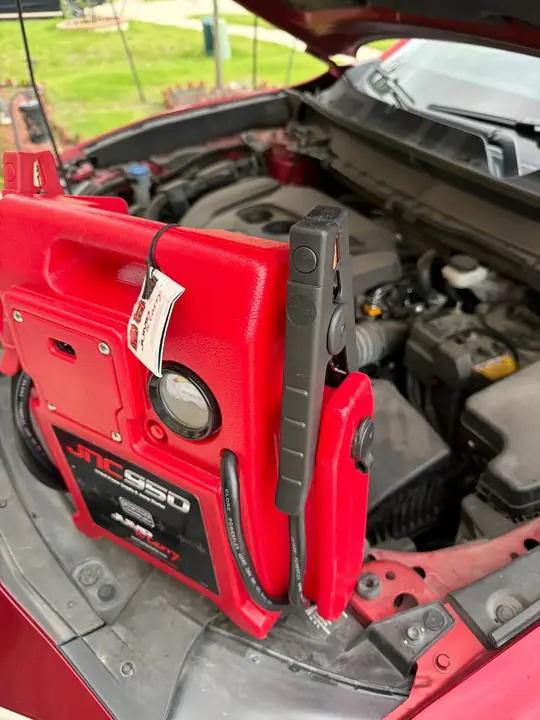
- We get you started — jump pack or quick charge.
- We run a digital load test on the battery (Midtronics CCA test, ~30 seconds).
- We test alternator output at the battery posts with the engine running. Healthy = 13.8–14.4V.
- We check for parasitic draw if the symptom is "dies overnight."
- If the battery passes, you drive off with a recommendation and we don't sell you anything you don't need.
- If the battery fails, we install a factory-spec replacement on-site — flooded, AGM, or EFB depending on your vehicle — with a 3-year warranty and free old-battery recycling.
Pricing in DFW
- Standard flooded (group 24F, 35, 51R, 65): quoted installed.
- AGM domestic (group H5, H6, H7): quoted installed.
- European AGM with BMS coding (BMW, Audi, Mercedes, Porsche): $279–$439 installed. See Luxury & European Battery Service.
- Mobile jump start (no replacement needed): $60 flat.
Every install includes mobile dispatch (20–30 minute ETA), correct group-size fitment, BMS/IBS registration where applicable, memory saver to preserve presets, old-battery recycling, and a 3-year limited warranty.
Get the Honest Answer — Free Load Test on Every Call
Call (682) 267-0991 for a mobile jump start or battery replacement anywhere in DFW — Dallas, Fort Worth, Plano, Frisco, Irving, McKinney, Lewisville, Arlington, and surrounding cities. Free load test on every call. If the battery is fine, we tell you so.