How to Jump a Dead Battery Safely — Step by Step (Texas Driver's Guide)
 By Dave Salazar
Connect red to dead (+), red to donor (+), black to donor (−), then black to bare metal on the dead car's engine block — never to the dead battery's negative post. Reverse the order to disconnect. The bare-metal ground rule prevents igniting hydrogen vented from a stressed battery.
A dead battery is the #1 roadside call we run in Dallas-Fort Worth — and the #1 cause of jump-start damage is people connecting cables in the wrong order. Done right, jumping a car takes 5 minutes and zero risk. Done wrong, you can short a battery, weld a wrench to a frame, fry an ECU module, or set off a hydrogen pop loud enough to crack a battery case. Here's the safe, factory-approved sequence — written by a roadside crew that does this 30+ times a week.
What You Need
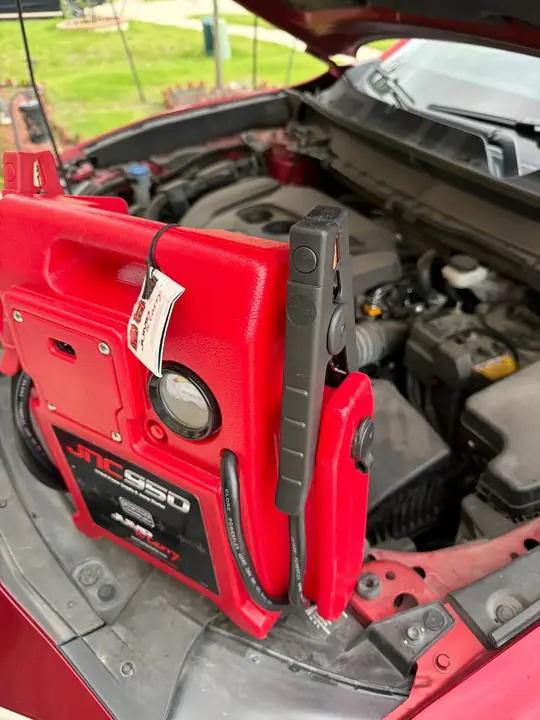
- A set of jumper cables (8-gauge minimum, 4-gauge ideal, 20+ feet long) or a portable jump pack (NOCO GB40, NOCO GB70, JNC950, Schumacher SL1639, etc.).
- A donor vehicle with a healthy 12V battery — same voltage as your dead car. Don't jump a 12V from a 24V commercial truck.
- Safety glasses if you have them. Closed-toe shoes. No loose jewelry on hands or wrists (rings + battery posts = welded ring on a finger).
Before You Connect Anything: Safety Check
- Inspect the dead battery. If the case is swollen, cracked, leaking, or smells like rotten eggs (sulfur), do not jump it. It's venting hydrogen and possibly sulfuric acid. Replace it, don't jump it.
- Check for ice in the cells if it's been below freezing. A frozen battery can rupture under jump current.
- Confirm voltage match. Both vehicles must be 12V systems. Most consumer cars and trucks are 12V; commercial diesels and some equipment run 24V.
- Park both vehicles close but not touching. Bumper-to-bumper is ideal. Set the parking brake on both. Both ignitions OFF, both keys OUT.
- Turn off all accessories on both cars — headlights, radio, climate, heated seats, phone chargers. The donor especially.
Step-by-Step: Jumper Cables (The Right Order)
- Identify positive (+) and negative (−) posts on both batteries. Red plastic cap or red sleeve = positive. Black = negative. The "+" and "−" are also molded into the battery case next to each post.
- Red clamp → dead car's POSITIVE (+) post. Clamp it firmly so it doesn't slip when you wiggle the cable.
- Red clamp → donor car's POSITIVE (+) post.
- Black clamp → donor car's NEGATIVE (−) post.
- Black clamp → bare metal on the dead car's engine block. A shock-tower bolt, an alternator bracket, or an unpainted bolt on the engine head all work. NOT the dead battery's negative post. (See the safety section below for why.)
- Start the donor car. Let it idle at slightly elevated RPM (1,500–2,000) for 2–3 minutes.
- Crank the dead car. Up to 5 seconds at a time, then wait 30 seconds between attempts. If it doesn't fire in 2–3 tries, stop — you have a different problem than a dead battery (see the troubleshooting section).
- If it starts, leave both running for another 2 minutes with the cables connected. This lets the recovered car's alternator stabilize.
- Disconnect in REVERSE order: black off the dead car's ground point → black off the donor → red off the donor → red off the dead car.
- Drive the recovered car at highway speed for 20–30 minutes to put real charge back in the battery. Around-the-block trips don't recharge anything meaningful.
Step-by-Step: Jump Pack (Safer Than Cables)
- Turn the ignition OFF. Confirm the pack is charged (most show LED state-of-charge).
- Connect the pack's RED clamp to the dead battery's POSITIVE (+) post.
- Connect the pack's BLACK clamp to bare engine metal — same ground rule as cables.
- Power the jump pack on. Most have a green "ready" light when polarity is correct. If you see red or hear a beep, you've reversed the clamps — fix it before powering on.
- Crank the engine. Most packs allow 3 attempts per minute. The pack does the heavy lifting; the vehicle's own battery just has to accept the boost current.
- As soon as it starts, disconnect BLACK first, then RED. Power off the pack and recharge it for the next time.
Why we use packs on every mobile call: Reverse polarity is the #1 way DIY jumps fry electronics. Quality packs detect polarity and refuse to fire if it's wrong. They also isolate the dead vehicle from a donor's electrical system, so a surge from the dead car can't damage the donor.
Why the Final Black Clamp Goes to Bare Metal, Not the Battery
Dead lead-acid batteries vent small amounts of hydrogen gas — colorless, odorless, and explosive at 4% concentration in air. The final clamp connection always produces a small spark as current rushes in. Putting that spark on the negative battery post, inches from the vent caps, is how you crack a battery case (best case) or get a face full of sulfuric acid mist (worst case). Grounding the final clamp to bare engine metal 12+ inches away from the battery keeps the spark safely away from any vented gas.
This is one rule we never bend — even on the 10,000th call.
5 Things That Will Damage Your Car (or You)
- Reversing polarity. Red to negative or black to positive blows fuses, fries ECU modules, kills the BCM, and can pop the battery. Cost on a modern car: $400–$2,500 in fuses, BCM, alternator diodes, or infotainment. On a Range Rover or BMW, more.
- Connecting the final black clamp to the dead battery. Spark + vented hydrogen = cracked battery case at minimum.
- Touching the clamps together while connected to one car. Welds the clamps and dumps short-circuit current through the donor electrical system. We've seen alternators burned out this way.
- Jumping a frozen battery. If you can see ice in the cells or the case is bulged, do not jump it. Replace it.
- Jumping a battery with corrosion volcanoes on the posts. Clean the corrosion first (baking soda paste, wire brush) or you'll get a poor connection that arcs.
Hybrids and EVs — Special Rules
Modern Toyota, Honda, Ford, and Hyundai hybrids have a 12V auxiliary battery that does exactly what a regular car battery does — boots the computers, fires the relays, wakes the high-voltage pack. When it dies, the car won't "READY." You jump that battery, not the high-voltage pack. The 12V is usually in the trunk, under the rear seat, or in a small compartment in the engine bay.
EVs (Tesla, Rivian, Lucid, Mustang Mach-E, ID.4) all have a 12V auxiliary too. Per the owner's manuals, you should use a jump pack on the 12V, not a donor car — high-voltage isolation faults can occur if a donor's electrical system fluctuates voltage during the connection. We use jump packs exclusively on EV calls.
Never connect anything to high-voltage orange cables. They run at 400–800V DC and can kill you instantly.
European Luxury Cars — Don't DIY It
BMW, Mercedes, Audi, Porsche, Land Rover, and Volvo with start-stop and AGM batteries are extra-sensitive. The IBS (Intelligent Battery Sensor) reads voltage spikes during jump events and can throw faults that disable start-stop, log the battery as "registered failed," and require dealer-level coding to clear. If your car has an AGM under the rear seat or in the trunk, call a mobile pro who carries a memory saver and BMS coding tool — see our Luxury & European Battery Service page for what's involved.
When NOT to Jump — Call Us Instead
Some "dead battery" calls aren't dead batteries. If you have any of these, call us instead of jumping it:
- Clicking sound but no crank — could be the starter, not the battery.
- Smell of rotten eggs (sulfur) from the engine bay — venting battery, dangerous.
- Battery case is swollen, cracked, or leaking.
- European luxury car (BMW, Mercedes, Audi, Porsche, Land Rover) — these need BMS-registered AGM replacement, not a parts-store jump.
- You've already jumped it once today and it died again — that's an alternator problem, not a battery problem.
- Smoke or burning smell from anywhere on the vehicle.
If the Jump Doesn't Work: Troubleshooting
- Single loud click when you turn the key. Starter motor solenoid is engaging but the starter won't spin. Could be a bad starter, a corroded connection, or the battery is too dead to deliver crank current. Try letting the donor charge it for 5–10 more minutes before re-cranking.
- Rapid clicking. Battery isn't getting enough current — usually a bad cable connection. Check that both clamps are tight on bare metal.
- Nothing at all. Dome light off, no dash lights — connection problem. Wiggle each clamp.
- Cranks but won't fire. Battery is fine. You have a fuel, ignition, or security-system issue. Stop cranking before you damage the starter.
DFW Mobile Jump Start — Anywhere, 24/7
No cables, no donor car, no jump pack? That's our entire job. Call (682) 267-0991 and we'll come to you across Dallas, Fort Worth, Arlington, Plano, Frisco, Irving, Lewisville, McKinney, and surrounding cities. We arrive in 20–30 minutes with a JNC950 jump pack, a voltmeter, and replacement batteries if the load test shows yours is gone.